
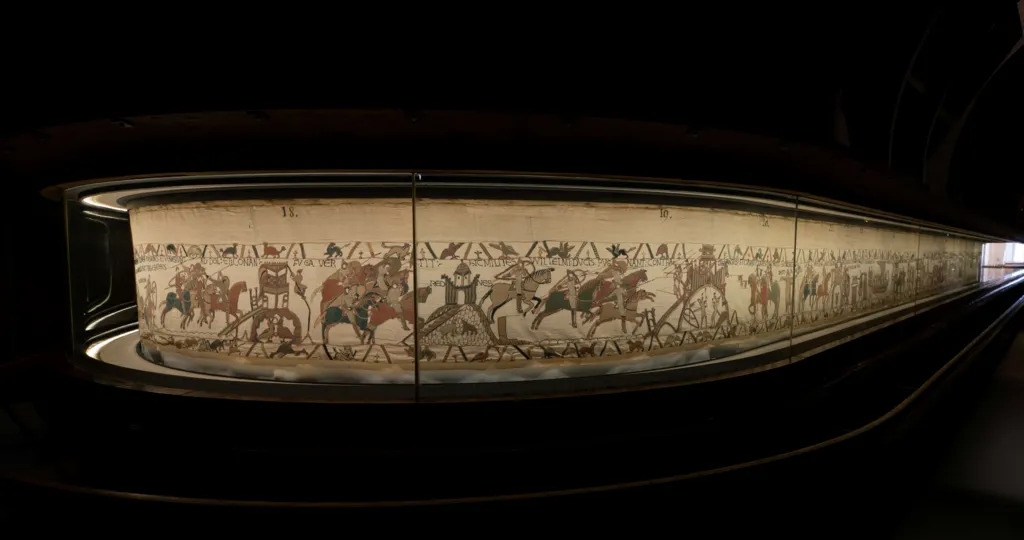
The nearly 950-year-old Bayeux Tapestry is preparing for a historic journey across the English Channel, marking only the third time the treasured medieval artwork has left its home in Bayeux, France. Scheduled to be displayed at the British Museum for nine months, the tapestry’s unprecedented loan has sparked both excitement and concern among historians, conservationists, and cultural leaders. French officials, however, insist that every precaution has been taken to ensure the safety of one of the world’s most valuable historical artifacts.
Engineering a Journey Fit for a Masterpiece
French cultural authorities have spent months developing a highly sophisticated transport system designed to protect the Bayeux Tapestry during its 560-kilometer journey to London.
Delphine Christophe, head of heritage and architecture at France’s Culture Ministry, expressed complete confidence in the operation.
“I am extremely serene,” Christophe said. “Nothing has been left to chance.”
To safeguard the delicate embroidery, the tapestry will be placed inside a specialized double-crate system. The artifact will rest in a climate-controlled aluminum case, which will then be enclosed within an outer protective cage fitted with 12 shock-absorbing springs.
According to conservation expert Cecilia Gauvin, the design transforms potentially damaging vertical impacts into gentle horizontal movements.
“The idea is that the vertical shocks which will occur are transformed into horizontal shocks, causing the inner crate to rock to and fro like a baby in a cradle,” Gauvin explained.
Testing Every Detail Before Departure
French officials conducted two full-scale trial runs to London using replicas of the tapestry, one in February and another in April. These tests allowed experts to evaluate how effectively the transportation system could absorb vibrations and shocks.
Kerstin Kracht, a specialist in vibration reduction, reported highly encouraging results.
“Don’t forget an artwork receives vibrations merely from the footsteps of all the visitors to a museum,” Kracht said.
The trials demonstrated that the protective system reduced shocks by 96%, bringing movement levels down to those routinely experienced by artworks displayed in museums.
Experts also analyzed road conditions along the route and discovered that roads in England contained more bumps and potholes than those in France. However, officials concluded that these differences posed no significant risk to the tapestry.
For security reasons, the exact transportation date remains undisclosed, though officials confirmed the move will occur sometime in July.
Critics Remain Concerned About the Risks
Despite the extensive preparations, some figures within France’s cultural community remain unconvinced that moving the Bayeux Tapestry is worth the risk.
Among the most vocal critics is prominent French arts journalist Didier Rykner, who argues that unforeseen circumstances could still threaten the fragile artifact.
“What happens if there is a problem in the tunnel and the lorry gets stuck there? These technical reports they have produced are meaningless – they’re just there to justify the political decision that’s already been taken,” Rykner said.
Many art historians have long maintained that the tapestry is too fragile and historically significant to be transported, regardless of the precautions taken.
A Medieval Treasure with a Remarkable History
The Bayeux Tapestry, which is technically an embroidered linen cloth rather than a woven tapestry, was created shortly after the Norman Conquest of England in 1066. The artwork vividly depicts the events leading up to the Battle of Hastings and the victory of William the Conqueror.
For centuries, it remained in Bayeux Cathedral before being rediscovered during the 18th century. It has only been relocated twice before: first in 1803 when Napoleon brought it to Paris as propaganda for a planned invasion of England, and again during World War II.
Its upcoming visit to London represents a rare opportunity for British audiences to view one of the most important visual records of medieval European history.
Cultural Diplomacy Strengthens Franco-British Relations
The loan agreement, announced by French President Emmanuel Macron in 2025, carries significant diplomatic importance.
The exchange is intended to reinforce ties between France and the United Kingdom during a period of geopolitical uncertainty. In return, Britain will loan several important artifacts to museums in Normandy, including the famous Lewis chess pieces and treasures from the Sutton Hoo burial site.
The exhibition also coincides with preparations for 2027 celebrations in Normandy marking the 1,000th anniversary of the birth of William the Conqueror, whose conquest of England remains the central story depicted in the embroidery.
As the Bayeux Tapestry prepares for its landmark journey to London, French authorities remain confident that years of planning, testing, and engineering have eliminated nearly every conceivable risk. While critics continue to question whether such a fragile treasure should travel at all, the exhibition promises to offer millions of visitors a rare chance to witness one of Europe’s most iconic historical artifacts. Beyond its cultural significance, the loan also serves as a powerful symbol of cooperation between France and Britain, connecting two nations through a shared medieval legacy nearly a millennium old.