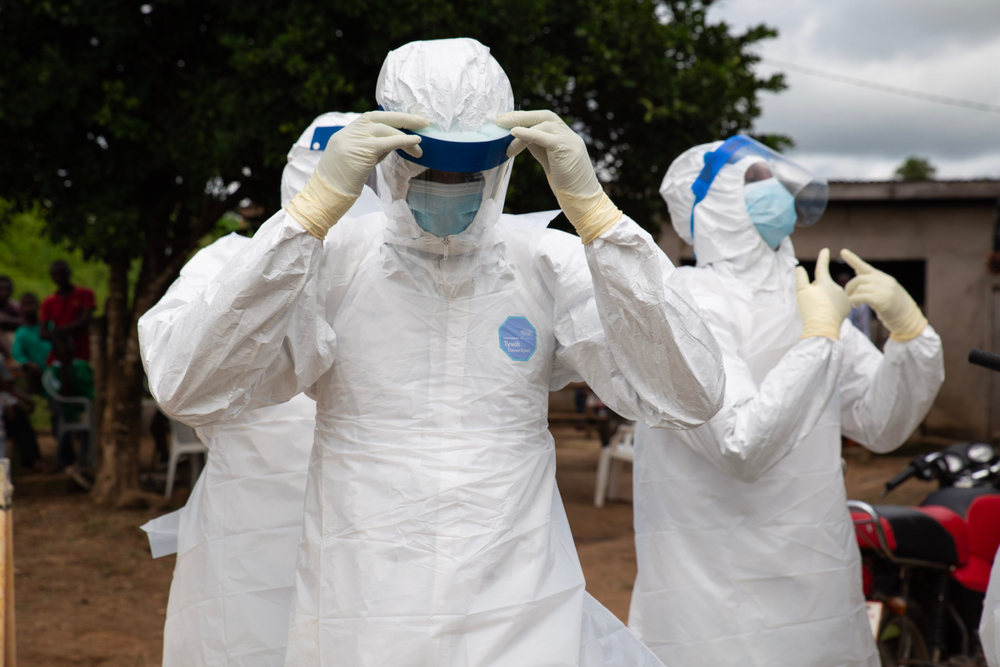
Cases continue rising across Central Africa
Nearly one month after the Democratic Republic of the Congo declared an Ebola outbreak, infections are still increasing and health authorities remain behind the virus.
As of Thursday, June 11, the DRC had recorded 676 confirmed cases and 136 deaths, along with 119 suspected infections. Neighbouring Uganda had reported 19 confirmed cases and two deaths.
Already the third-largest outbreak recorded
The outbreak is linked to the Bundibugyo strain of Ebolavirus and has already become the third-largest Ebola epidemic on record.
Public health specialists fear the true scale may be considerably greater because the virus appears to have circulated for months before officials formally declared the outbreak on May 15.
Investigators search for the earliest infections
Congolese health officials are now working backward through the transmission chain in an effort to identify the first known case.
Investigators are examining whether a funeral held on February 4 in Mongbwalu, a remote gold-mining town, may have been an early superspreading event.
A pastor’s funeral becomes a key focus
The funeral was held for a 44-year-old pastor whose death had been attributed to a severe abdominal infection. He was never tested for Ebola, but officials now believe his illness may have been connected to the virus.
More than 80 people attended the ceremony. In the days that followed, numerous relatives and community members became ill.
Within two weeks, the town had recorded nearly 50 deaths among people who had reported symptoms consistent with Ebola.
CDC modeling warns of a much larger crisis
As investigators continue to determine how widely the virus has spread, the U.S. Centers for Disease Control and Prevention has published models examining how the outbreak could develop.
The central conclusion is that rapid and forceful public health measures, particularly contact tracing and case isolation, will be essential to prevent the epidemic from growing dramatically.
Worst-case models exceed 20,000 cases
Under one severe CDC scenario, only 20% of Ebola patients would be successfully isolated.
Most simulations under those conditions produced more than 20,000 infections and over 4,000 deaths within three months.
Such an outcome would place the outbreak close to the scale of the 2014 to 2016 West Africa epidemic, which caused more than 28,000 cases and 11,000 deaths.
International response is weaker than before
The global response has been affected by the United States’ withdrawal from the World Health Organization and the dismantling of the U.S. Agency for International Development.
American financial and operational support has arrived more slowly and at a lower level than during previous Ebola emergencies, weakening the broader international effort.
U.S. quarantine policy creates controversy
The Trump administration has focused heavily on border restrictions and travel controls.
Its current plans could prevent even U.S. citizens from immediately returning home if they have been exposed to or infected with Ebola.
Instead, the administration is attempting to establish a temporary quarantine facility at a military base in Kenya, even though Kenya has not reported cases linked to the outbreak.
Kenyans protest the quarantine facility
The proposal has triggered intense opposition in Kenya, where critics accuse the government of accepting a public health risk that the United States is unwilling to manage on its own territory.
The Kenya Medical Practitioners, Pharmacists and Dentists Union said it was deeply disturbed by what it described as a willingness to compromise national biosecurity in exchange for foreign assistance.
Hundreds of people have joined demonstrations in Nanyuki, the town closest to the military base.
Protests turn deadly
Clashes between protesters and police have resulted in at least three deaths, according to the Kenya Human Rights Commission.
The unrest reflects growing public anger over the possibility that exposed or infected travellers could be brought into a country that is currently outside the outbreak zone.
Court intervention has not stopped preparations
A Kenyan court temporarily suspended the opening of the quarantine facility.
Despite that ruling, the Trump administration has continued moving forward with preparations, deepening tensions between public health officials, local communities and the Kenyan government.
Speed will determine the outbreak’s trajectory
The outbreak’s final scale will depend heavily on how quickly authorities identify contacts, isolate patients and expand testing and treatment capacity.
The suspected spread before May means response teams are not simply containing new cases. They are also trying to reconstruct months of transmission across remote communities and national borders.
Without a stronger and more coordinated response, health experts warn that the current outbreak could become one of the most severe Ebola emergencies ever recorded.